
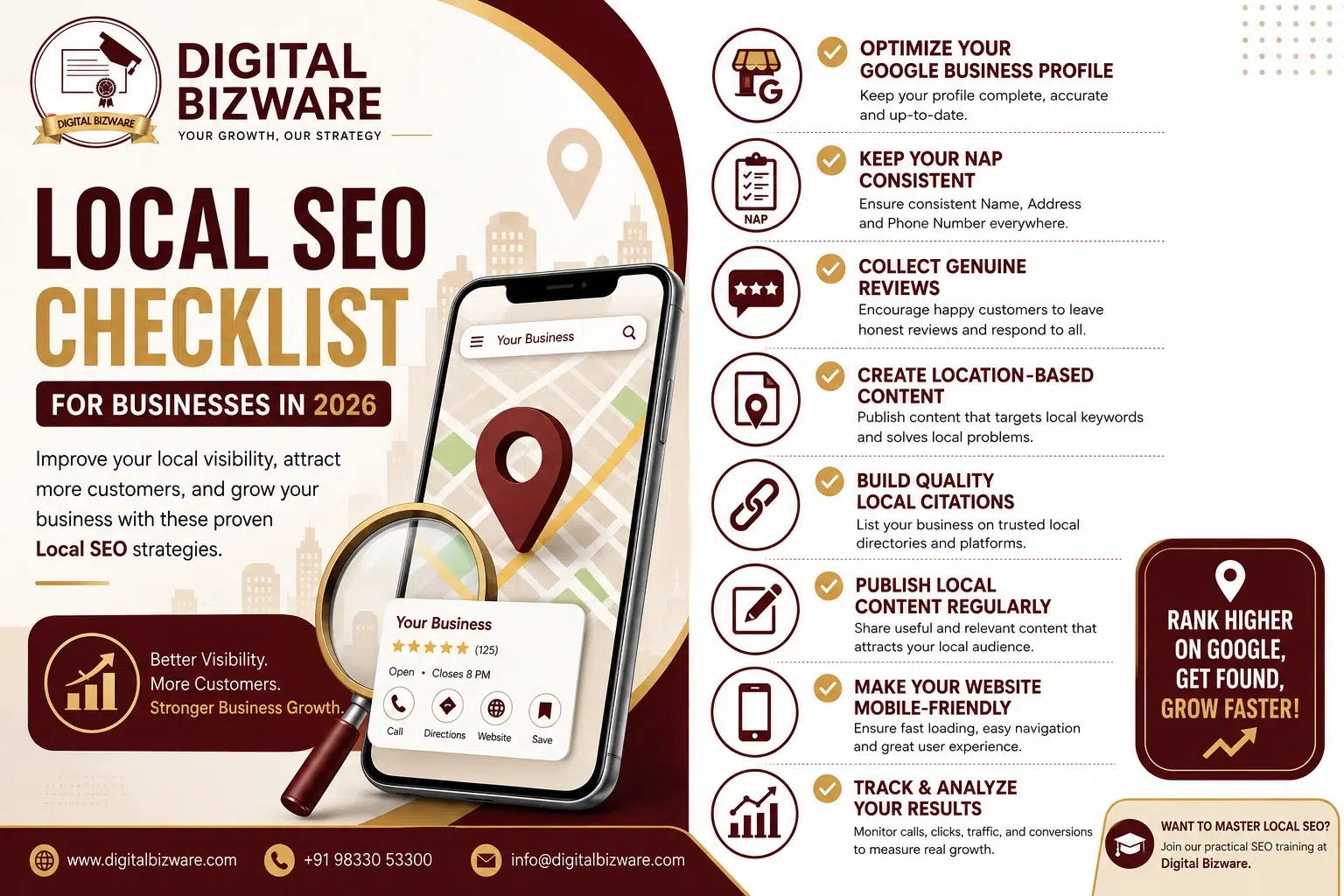
Local SEO Checklist for Businesses in 2026: 11 Practical Tips That Actually Matter
Introduction
Let’s be honest. Having a website doesn’t automatically mean people in your area will find your business.
You could have a great product, reasonable prices, and excellent service, but if your business doesn’t appear when people search locally, you’re missing potential customers.
This is exactly why a Local SEO Checklist tips is useful.
Local SEO helps your business show up when people search for products or services around them. And in 2026, local search is becoming even more important because customers want quick answers, nearby options, reviews, directions, and businesses they can trust.
The good news? You don’t need to be an SEO expert to get started.
You simply need to work on the right things consistently.
What Should a Local SEO Checklist Include?
A good local SEO plan covers more than just keywords.
You need to look at your Google Business Profile, website, reviews, local content, business information, mobile experience, backlinks, and customer behavior.
In simple words, the goal is to make your business easy to find, easy to understand, and easy to trust.
If you’re a local business, don’t treat your Google Business Profile as something you set up once and forget.
Check your business name, category, phone number, address, website, working hours, services, and other important details.
Even a small mistake can create confusion for customers.
Keep Adding Fresh Information
Upload real photos from your business.
Add updates when something important changes. Keep your opening hours accurate, especially during holidays.
Think of your profile as your shop window on Google. Would you leave your physical shop looking exactly the same for two years?
Probably not.
This is where many businesses go wrong.
They choose keywords they think sound good instead of researching what potential customers actually type into Google.
For example, someone looking for training may search for “digital marketing course in Thane,” while another person may type “digital marketing classes near me.”
Both searches show local intent, but the wording is different.
Focus on Meaning, Not Repetition
Use keywords naturally throughout your website.
You don’t need to repeat one phrase in every paragraph. Google’s systems are much better at understanding context than they used to be.
Write for the person first and optimize for search engines second.
1.Make Your Website Clearly Local
Your website should make it obvious where you operate.
Mention your service areas naturally on relevant pages. If you have different branches or genuinely serve different locations, create useful location pages for them.
But don’t create twenty pages that say almost exactly the same thing with only the city name changed.
That’s not useful to anyone.
2.Check Your Business Information
Here’s a simple task many businesses overlook.
Search your own company name on Google.
Look at directories, social profiles, maps, business listings, and other websites where your company appears.
Is the phone number correct?
Is the address current?
Are the opening hours still accurate?
If you find outdated information, fix it wherever possible.
3.Keep Your NAP Consistent
NAP stands for Name, Address, and Phone Number.
Keeping these details consistent across important business listings makes your online presence more reliable and reduces confusion for customers.
4.Ask Happy Customers for Honest Reviews
Reviews can have a huge influence on someone’s decision.
Think about it. If you’re choosing between two businesses you’ve never used before, wouldn’t you look at what previous customers said?
Make it easy for genuine customers to leave feedback after a positive experience.
And don’t write fake reviews for yourself. It may seem like a shortcut, but it’s a terrible foundation for a business reputation.
5.Reply Like a Real Person
Someone leaves a good review? Thank them.
Someone has a genuine complaint? Respond professionally and try to resolve the issue.
A business that responds thoughtfully can often make a better impression than one that ignores customers completely.
7.Create Content About Your Local Customers
Your blog doesn’t always have to target huge national keywords.
Sometimes, smaller local topics can bring much more relevant visitors.
For example, a fitness center could write about fitness options for working professionals in its area.
A real estate company could explain what first-time buyers should know about a particular locality.
A digital marketing institute could discuss career opportunities and digital skills for students in its city.
The best local content answers questions your actual audience cares about.
8.Don’t Forget Your Mobile Website
Imagine someone searching for your business while sitting in a cab or walking down the street.
They’re probably using a smartphone.
If your website takes forever to load or the contact button is impossible to find, you’ve already created a problem.
Check your website on your own phone.
Can you read the text comfortably?
Can you find the phone number?
Can you understand what the business offers within a few seconds?
If not, make improvements.
9.Build Real Local Connections
Local SEO isn’t only about your website.
Your business can also become more visible by being genuinely involved in its community.
Consider partnerships with local businesses, community events, industry associations, local publications, or relevant organizations.
These relationships can sometimes lead to valuable mentions and backlinks.
10.Quality Beats Quantity
Don’t chase hundreds of random links.
One relevant mention from a respected local or industry website can make much more sense than a pile of unrelated links.
11.Show People the Real Business
Customers like knowing what they’re getting into.
Use genuine photos of your office, store, team, products, events, work, or facilities.
This is especially important for businesses where appearance and experience influence buying decisions.
Real photographs can make your business feel more approachable.
12.Measure What Is Actually Happening
Don’t judge your entire SEO campaign only by keyword rankings.
Look at what happens after people discover you.
Are website visits increasing?
Are people calling?
Are they asking for directions?
Are enquiries going up?
Are more people interacting with your Google Business Profile?
These numbers tell you much more about whether your local SEO efforts are helping the business.
13.Prepare for AI-Powered Search
Search is changing quickly.
People are asking longer and more conversational questions, and AI is becoming a bigger part of how information is discovered.
This doesn’t mean traditional SEO is dead.
It means businesses need to provide clearer, more useful information.
Answer customer questions properly. Explain your services. Keep business information accurate. Show real expertise.
Don’t create content just because an AI tool can produce it in thirty seconds.
Key Benefits of Local SEO
A strong local presence can help a business:
Perhaps the biggest benefit is that local SEO puts your business in front of people who are already looking for something you provide.
That’s much more valuable than simply getting random website visitors.
Challenges Businesses May Face
Local SEO sounds straightforward, but staying consistent can be difficult.
Business information gets outdated. Competitors become more active. Reviews need attention. Websites need improvements. Google keeps changing how search works.
Another common problem is impatience.
A business may optimize its profile today and expect a dramatic increase in customers tomorrow.
SEO usually doesn’t work that way.
It takes testing, consistency, patience, and regular improvements.
The Future of AI in Digital Marketing
AI will become increasingly useful for marketers.
It can help with research, data analysis, customer insights, content ideas, reporting, automation, and repetitive marketing tasks.
But there’s an important difference between using AI and letting AI do everything.
Where Humans Still Make the Difference
AI can suggest ten content ideas.
You still need to decide which one actually makes sense for your customers.
AI can analyze customer reviews.
You still need to understand what your business should improve.
AI can help write content.
You are responsible for checking whether that content is accurate, useful, and genuinely relevant.
The Smart Approach
The future isn’t about humans versus AI.
It’s about marketers who know how to combine both.
A marketer who understands SEO fundamentals and also knows how to use AI tools efficiently will have a strong advantage in the coming years.
Frequently Asked Questions
AI can help marketers with research, content planning, customer analysis, reporting, automation, personalization, and campaign optimization.
1.Can AI replace digital marketing professionals?
AI can automate certain repetitive tasks, but it cannot completely replace strategic thinking, creativity, communication, and business understanding.
2.Can AI help with local SEO?
Yes. AI can help identify content opportunities, analyze customer questions, organize information, and speed up research. Human review is still important.
3.Is AI-generated content good for SEO?
AI-generated content can be useful when it is carefully reviewed and genuinely helps the reader. Publishing generic AI content at scale simply to get rankings is not a good SEO strategy.
4.Should beginners learn AI along with digital marketing?
Yes. Learning AI tools alongside SEO, social media, Google Ads, analytics, and content marketing can help beginners become more productive and better prepared for modern marketing jobs.
Conclusion
Local SEO isn’t about finding one magic trick that suddenly puts your business at the top of Google.
It’s about getting the small things right—and continuing to improve them.
Keep your business information accurate. Give customers a reason to trust you. Publish useful content. Take care of your website. Collect genuine reviews. Pay attention to what your visitors actually do.
That’s what makes a Local SEO Checklist useful in the real world.
And as AI continues changing digital marketing, one thing will remain important: businesses need people who understand how marketing actually works.
Ready to Build Your Digital Marketing Skills?
Digital marketing is moving fast. New AI tools will appear, search behavior will change, and businesses will continue looking for people who can adapt.
So don’t just learn how to use one tool.
Build a proper foundation in SEO, Google Ads, social media marketing, content marketing, analytics, and AI-powered marketing.
Practice what you learn. Work on real projects. Make mistakes. Improve.
That’s how skills turn into confidence—and eventually into career opportunities.
Start learning today and give yourself the skills to compete in tomorrow’s digital world.
Explore digital marketing training at Digital Bizware.