

Imagine asking an AI chatbot to explain a difficult concept, generate an image or help you write an article. Within seconds, you receive an answer. The process feels almost magical, but behind that simple interaction lies a network of powerful computers, electricity systems and data centres that require physical resources to operate.
One of those resources is water.
As artificial intelligence becomes part of education, healthcare, business and everyday life, its environmental impact deserves closer attention. Water can be used to cool data centres, generate electricity and manufacture the specialised chips that power AI systems. However, the amount varies considerably depending on the technology and location.
So, does every AI question waste water? How much water does this technology actually consume? And can AI continue growing without placing unnecessary pressure on freshwater supplies?
Understanding the answers requires looking beyond the screen and into the infrastructure powering the AI revolution.
AI systems operate on computers housed in data centres. These facilities contain servers and specialised processors that perform billions of calculations, generating heat as they work. Without effective cooling, equipment can overheat and become less reliable.
Some data centres use evaporative cooling, which removes heat as water evaporates. Others use air cooling, liquid cooling or combinations of different technologies.
Water is also required indirectly. Power plants may consume water while generating the electricity that AI servers need, while semiconductor factories use highly purified water during chip manufacturing.
This does not mean every AI system directly uses water whenever someone submits a prompt. Instead, water consumption occurs across different stages of the infrastructure supporting the technology.
The important distinction is that AI is digital in its output, but physical in the resources needed to deliver it.
AI’s water footprint can be divided into three major categories.

Servers produce heat continuously, particularly when large numbers of computing tasks run simultaneously. Evaporative cooling systems use water to remove this heat, and some of that water enters the atmosphere through evaporation.
Other cooling designs can reduce or avoid direct evaporative water use, although their overall environmental impact depends on how they operate and how electricity is generated.
AI requires electricity for training models and responding to user requests. Some electricity-generating technologies consume water for cooling or other processes.
Consequently, a data centre with relatively low on-site water consumption may still have an indirect water footprint associated with its electricity supply. The size of that footprint depends partly on the energy sources used.
AI chips are manufactured in specialised facilities that require ultrapure water to clean silicon wafers and remove microscopic contaminants. Producing and treating this water also requires resources.
Manufacturing-related water use differs from operational cooling because it is associated with producing the hardware rather than running an individual AI request.
Considering all three categories provides a more complete picture than measuring only the water used inside data centres. Research published in Communications of the ACM in 2025 highlights the importance of accounting for on-site cooling, electricity generation and hardware supply chains when assessing AI’s water footprint.
There is no single reliable figure that describes the water consumption of every AI system. However, published research offers useful insights into the scale of the issue.
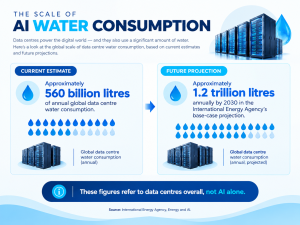
The International Energy Agency’s Energy and AI report estimated that global data-centre water consumption was approximately 560 billion litres annually, with its base-case projection reaching around 1.2 trillion litres per year by 2030. These figures cover data centres overall, not AI alone. They also represent a projection based on assumptions about future infrastructure and demand.
This distinction matters because data centres support many services, including cloud computing, websites, business applications and streaming, alongside AI.
A more specific example comes from Google-affiliated researchers who published a study in August 2025 examining the environmental impact of serving its Gemini AI assistant. They estimated that a median text prompt in Gemini Apps consumed approximately 0.26 millilitres of water, equivalent to about five drops, under their measurement methodology.
That is a useful real-world measurement, but it is not a universal figure for all AI chatbots. Different models, hardware configurations, cooling systems and electricity sources can produce different results.
The evidence therefore supports two conclusions: data centres can consume substantial quantities of water collectively, while the precise share attributable to AI remains difficult to establish.
No. Treating every AI interaction as if it had an identical water cost oversimplifies the issue.
A short text response generally requires a different amount of computation from generating a detailed image, producing a video or processing a lengthy request. The model’s size, hardware efficiency, response length and number of calculations all influence electricity demand.
Cooling systems and local weather conditions also matter. A data centre operating in a hot climate may have different cooling requirements from one operating in a cooler region. Likewise, the electricity mix can change the amount of water consumed indirectly.
This explains why estimates published by different researchers may vary considerably.
The Gemini study mentioned earlier measured a particular service using a defined methodology. Its result should not automatically be applied to ChatGPT, other AI tools or every possible task.
A responsible article about AI and water must therefore explain the assumptions behind a statistic rather than presenting a single number as a universal fact.

Microsoft’s water-reuse initiative in Quincy, Washington, provides an example of how infrastructure changes can reduce demand for drinking-quality water.
The company worked with the local municipality to develop a water-reuse facility that recycles water associated with data-centre cooling. Microsoft has reported substantial reductions in its regional potable-water use through this initiative, although its published figures have been updated as reporting methods have changed.
The broader lesson is that reducing water demand is not limited to using less computing power. Infrastructure design, water treatment and cooperation with local communities can also make a difference.
However, the success of one project does not prove that every data centre can achieve the same results. Local water availability, cooling requirements, treatment capacity and operating conditions all influence what is practical.
Case studies are most useful when they demonstrate a specific solution without suggesting that one company’s experience represents the entire industry.
Water consumption becomes particularly important when facilities operate in regions already experiencing water stress.
A data centre’s impact depends on more than its total water use. The source of the water, local climate, competing demand and the availability of alternative supplies all influence the consequences.
For example, using appropriately treated wastewater for cooling can reduce pressure on freshwater supplies. By contrast, consuming freshwater in a drought-prone region may create greater concerns for households, agriculture and ecosystems.
Timing also matters. Water demand during a drought can have different consequences from the same demand when supplies are more abundant.
This does not mean every data centre threatens local communities. It means companies should assess local water conditions before expanding, while governments should consider the combined impact of multiple facilities.
The goal should be to ensure that technological growth does not create avoidable pressure on essential water resources.
Several common claims about AI and water need closer examination.
Myth: Every AI prompt consumes the same amount of water.
Fact: Water use varies with computing requirements, infrastructure efficiency, cooling technology and electricity sources.
Myth: Every data centre uses drinking water for cooling.
Fact: Some facilities use freshwater, while others can use reclaimed or recycled water. The available options depend on local infrastructure and water quality.
Myth: Reducing direct cooling water eliminates AI’s entire water footprint.
Fact: Electricity generation and semiconductor manufacturing can also contribute to water consumption.
These distinctions matter because environmental discussions are more useful when they explain what is measured, what is estimated and what remains uncertain.
Yes. Technology companies can take several practical steps to reduce the water footprint of their AI infrastructure.

Improve cooling systems: Efficient air cooling, closed-loop liquid cooling and alternative heat-management designs can reduce direct water demand in suitable conditions.
Reuse and recycle water: Appropriately treated wastewater can replace some freshwater used in industrial cooling. Rainwater collection may also help where climate and infrastructure make it feasible.
Improve computing efficiency: Better processors, optimised software and appropriately sized AI models can reduce the electricity required for certain tasks. This can also reduce indirect water consumption, depending on the power supply.
Choose locations carefully: Companies should consider local water stress, climate conditions, electricity sources and community requirements before building new facilities.
Improve transparency: Companies should disclose water consumption, water withdrawal, water sources and relevant local impacts. Reporting these measures separately makes environmental claims easier to evaluate.
No single solution will eliminate AI’s environmental footprint. A combination of engineering, efficient computing, responsible planning and transparent reporting offers a more realistic path forward.
AI infrastructure is likely to remain an important environmental consideration as demand for digital services grows. However, future water consumption will depend on more than the number of users.
Advances in hardware, cooling technologies, water reuse and data-centre design may improve efficiency. At the same time, rising computing demand could offset some of those gains.
This creates a challenge for technology companies and policymakers: efficiency improvements must be measured alongside overall resource consumption.
More transparent reporting and better research will help determine whether the industry is reducing its environmental impact or simply expanding more efficiently.
The future should be judged by measurable outcomes rather than promises alone.
ChatGPT relies on computing infrastructure that can consume water directly through cooling and indirectly through electricity generation. The exact amount depends on the systems and conditions involved.
There is no universal figure. Google’s 2025 study estimated approximately 0.26 millilitres for a median Gemini Apps text prompt under its specific methodology. Other AI systems may have different footprints.
Some AI infrastructure can operate with little or no direct water consumption for cooling. However, electricity generation and hardware manufacturing may still have associated water footprints.
They can improve cooling efficiency, use suitable recycled water, optimise computing workloads and select locations with water availability in mind.
It can be, particularly in water-stressed regions. The level of concern depends on local conditions, the water sources used and how efficiently facilities operate.
Artificial intelligence offers enormous possibilities, but its digital convenience should not make its physical resource requirements invisible. Water is an important part of that equation, from cooling servers to generating electricity and manufacturing chips.
The evidence shows that data centres can consume substantial amounts of water, while the precise contribution of AI remains difficult to measure. The answer is not to exaggerate the problem or ignore it, but to improve efficiency, reuse water where appropriate and demand transparent reporting.
The future of AI should not be measured only by what machines can achieve, but also by how responsibly we build and operate them.
Enjoy reading informative articles about artificial intelligence, technology and digital marketing? Stay tuned to Digital Bizware for more insightful, research-backed content that helps you stay informed about the latest industry trends.
Looking to develop practical skills and advance your career? Explore our digital marketing courses and professional training programs.
Visit our website: www.digitalbizware.com
Learn. Grow. Stay Ahead with Digital Bizware!