
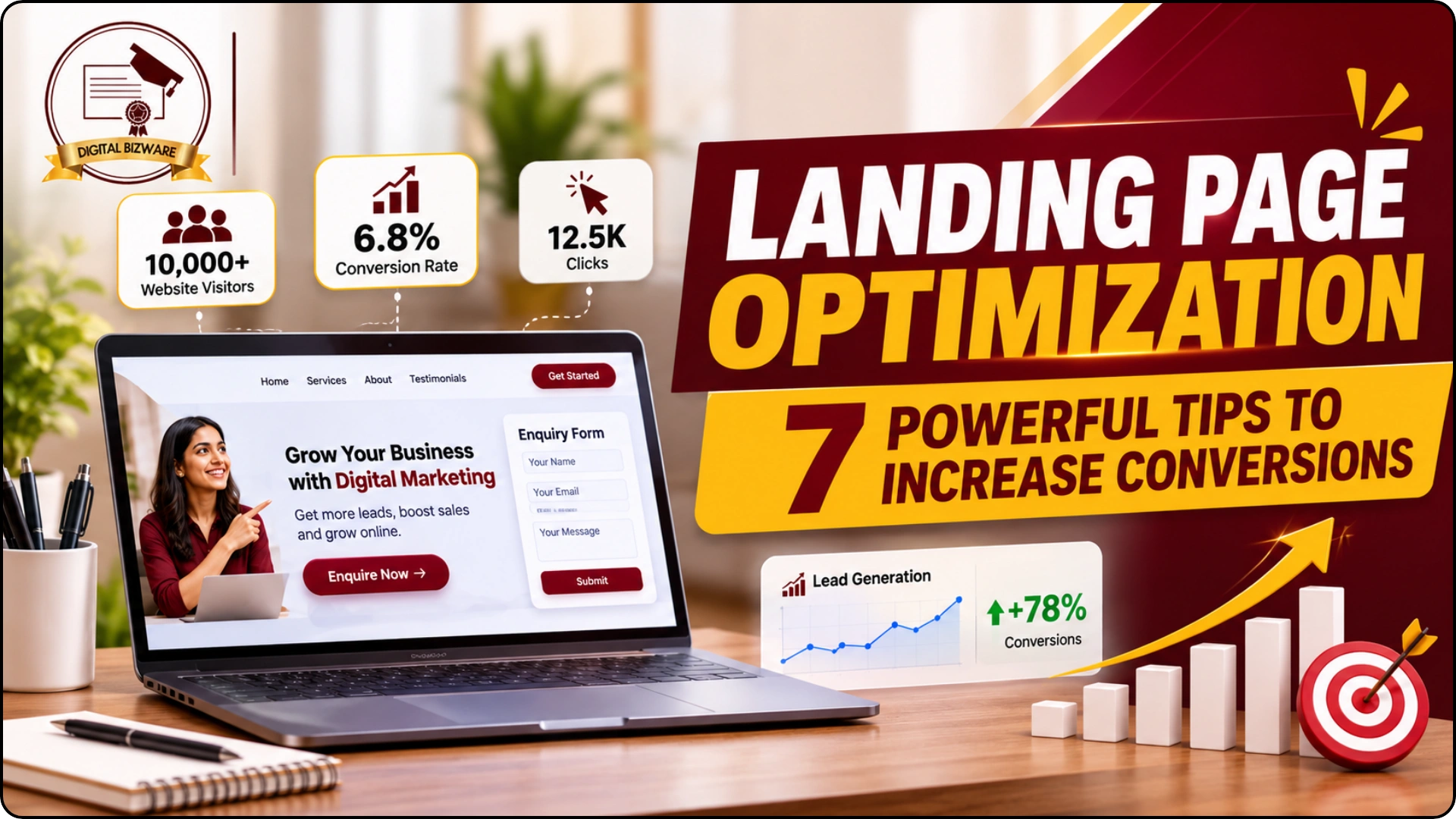
7 Powerful Landing Page Optimization Tips That Increase Conversions
Introduction
Imagine spending thousands of rupees on Google Ads or Meta Ads, attracting hundreds of visitors to your website, but receiving hardly any enquiries. Sounds frustrating, right? The problem might not be your advertising campaign but your landing page.
Implementing the right landing page optimization tips can turn ordinary website visitors into potential customers. A well-designed landing page communicates your offer clearly, builds trust, and encourages visitors to take action.
Whether you run an online business, provide services, or generate leads through digital marketing campaigns, optimizing your landing page can make a significant difference.
What Is Landing Page Optimization?
Landing page optimization involves making improvements to a webpage so visitors are more likely to take action, whether it’s submitting an enquiry, purchasing a product, booking a consultation, or signing up for a course.
If you want to explore more strategies, check out this helpful guide on landing page optimization by Semrush, which covers additional ways to improve landing page performance and user experience.
The primary objective is simple: deliver a better user experience and increase conversions without necessarily increasing advertising expenses.
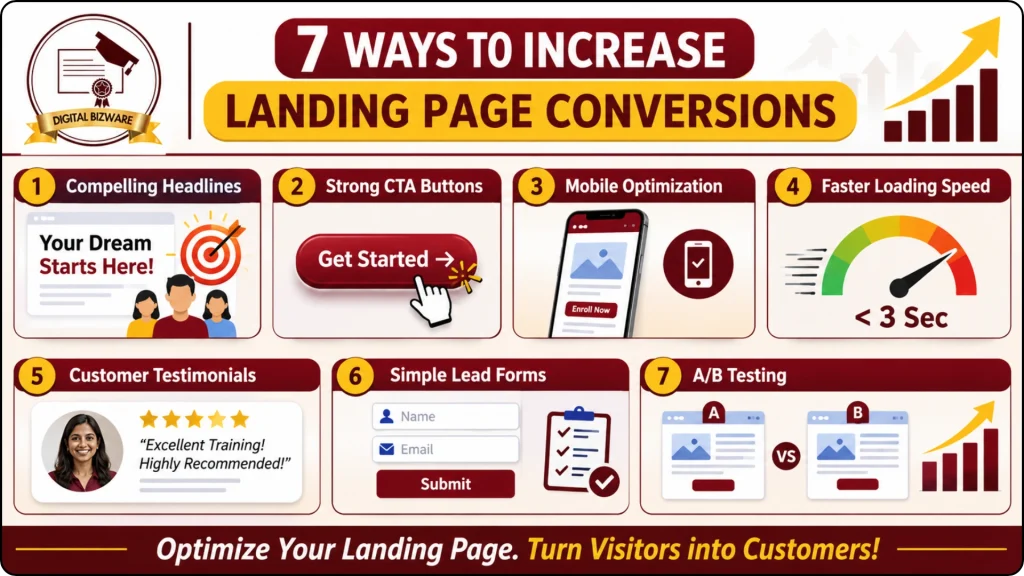
7 Powerful Landing Page Optimization Tips to Increase Conversions
1. Create an Attention-Grabbing Headline
When someone visits your landing page, the headline is usually the first element that grabs their attention. If it fails to communicate your offer, visitors may leave without exploring the page.
Write a clear, benefit-focused headline that immediately answers what you offer and why someone should choose you.
For example, instead of writing “Digital Marketing Training”, try “Master Digital Marketing Skills with Practical Industry Training.”
A compelling headline creates curiosity and gives visitors a reason to continue reading.
2. Add a Clear and Compelling Call-to-Action
A call-to-action (CTA) guides visitors towards the next step. Without it, people may understand your offer but remain unsure about what to do.
Use action-oriented phrases such as:
- Enquire Now
- Book Your Free Demo
- Get Started Today
- Download Your Free Guide
Place your primary CTA above the fold and repeat it at relevant points throughout longer pages.
3. Make Your Landing Page Mobile-Friendly
A large percentage of website visitors browse using smartphones. Therefore, a landing page that looks attractive on desktops but difficult to navigate on mobile can lose valuable enquiries.
Follow these mobile-friendly practices:
- Use readable font sizes.
- Keep buttons large enough to tap.
- Avoid unnecessary pop-ups.
- Make forms simple to complete.
- Maintain proper spacing between sections.
A smooth mobile experience helps visitors interact with your website comfortably.
4. Improve Website Loading Speed
Nobody likes waiting for a slow website. Even an attractive landing page can lose potential customers if its content takes too long to load.
Compress images, remove unnecessary plugins, enable browser caching, and use reliable hosting.
You can also test your website using Google PageSpeed Insights to identify performance issues and improvement opportunities.
Fast-loading pages create a smoother browsing experience and support your overall SEO efforts.
5. Strengthen Customer Confidence Through Reviews and Testimonials
Before submitting an enquiry or purchasing a service, visitors want to know whether your business is trustworthy.
This is where social proof becomes important.
Show visitors why they should trust your business by including authentic customer feedback, success stories, professional certifications, case studies, and notable achievements.
For example, an educational institute can display genuine student feedback, course information, and practical learning outcomes.
These elements reduce hesitation and help visitors feel more confident about taking action.
6. Keep Your Lead Generation Forms Simple
Long forms can discourage visitors from completing an enquiry.
Ask only for essential information, such as name, phone number, and email address, when these details are sufficient for the initial enquiry.
Avoid unnecessary questions that create additional effort.
Pro tip: Use clear field labels, helpful error messages, and a privacy statement near the submission button.
A simple form makes the conversion process easier and more convenient.
7. Perform A/B Testing and Track Performance
Never assume that your first landing page design is perfect. Sometimes, changing a headline, button colour, image, or form layout can produce different results.
A/B testing involves comparing two versions of a landing page to understand which performs better.
Track important metrics such as:
- Conversion rate
- Bounce and engagement trends
- Form submissions
- Click-through rate
- Cost per lead
Use analytics tools to understand visitor behaviour and make improvements based on actual data.
Key Benefits of Landing Page Optimization
Applying effective landing page optimization tips offers several advantages:
- Higher conversions: Encourage more visitors to complete desired actions.
- Better user experience: Make navigation and interactions easier.
- Improved lead quality: Attract visitors who are genuinely interested in your offer.
- Better advertising performance: Create consistency between advertisements and landing page content.
- Lower acquisition costs: Generate more results from existing website traffic.
Common Landing Page Optimization Challenges
Even businesses with good marketing campaigns face certain challenges.
Some common problems include unclear messaging, slow loading speed, complicated forms, poor mobile responsiveness, and a lack of trust signals.
Another major challenge is making changes without tracking results.
The solution is to understand your target audience, monitor performance regularly, and improve one element at a time.
Frequently Asked Questions (FAQs)
1. What are the best landing page optimization tips?
The best practices include writing compelling headlines, creating strong CTAs, improving page speed, simplifying forms, adding testimonials, and optimizing mobile experiences.
2. How can I increase my landing page conversion rate?
Understand your audience, communicate your offer clearly, remove unnecessary distractions, and test different page elements to identify what works best.
3. Why is mobile optimization important for landing pages?
Mobile optimization ensures that visitors can easily read content, navigate sections, and submit enquiry forms using smartphones.
4. Does landing page optimization help SEO?
Yes. Improving page speed, mobile usability, content relevance, and user experience can support SEO performance. However, conversion improvements do not automatically guarantee higher Google rankings.
5. How often should I optimize my landing page?
Review performance regularly and test improvements whenever you identify issues or new opportunities. Avoid making decisions based on insufficient data.
Conclusion
A successful landing page is not just about attractive design. It is about understanding customer behaviour, communicating value, building trust, and making the conversion process effortless.
By implementing these landing page optimization tips, businesses can improve their website experience, attract quality enquiries, and make better use of their digital marketing investments.
Remember, successful digital marketing requires more than running advertisements. You must understand SEO, website development, lead generation, analytics, and conversion strategies.
Want to build practical digital marketing skills and learn how businesses generate quality leads online?
Explore professional training opportunities at Digital Bizware and take the next step towards becoming a skilled digital marketing professional.
Visit Digital Bizware and explore our Lead Generation Courses in Thane to start your learning journey today.